GRID / 天格计划
A Nanosatellite Constellation for Gamma-Ray Burst Detection / 伽马暴探测纳卫星星座
Project Overview / 项目概览
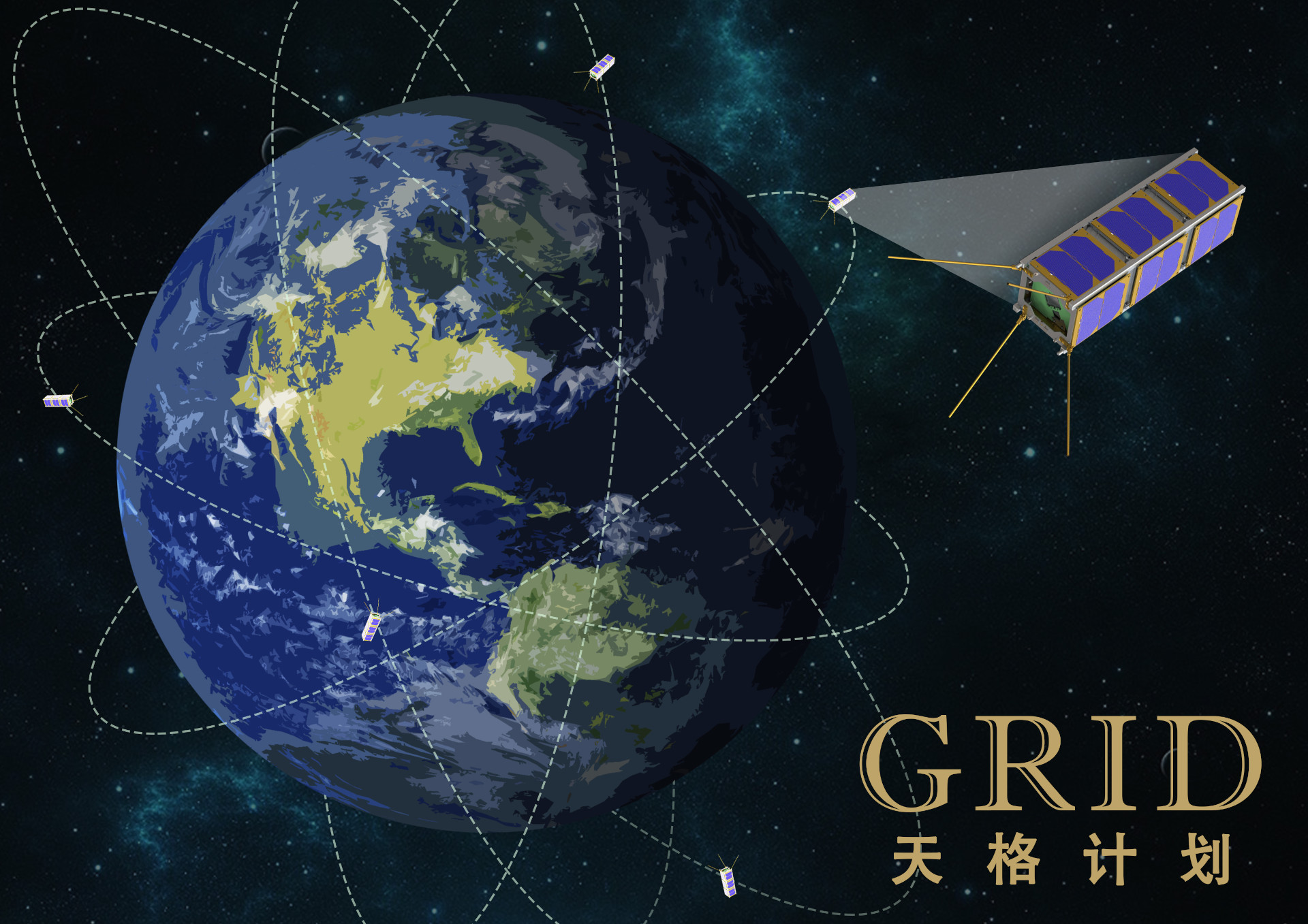
GRID is a space mission designed to monitor transient gamma-ray sources using a constellation of nanosatellites. Initiated by Tsinghua University undergraduate student Jiaxing Wen in 2016 under the supervision of Professors Ming Zeng and Hua Feng, the project has launched 13 satellite payloads to date (as of 2025), with 5 detectors currently operational on orbit, establishing a preliminary nanosatellite scientific observation constellation to explore full-time and all-sky monitoring of gamma-ray bursts (GRBs). The development and in-orbit scientific observation of each satellite payload are led and executed by student teams themselves, with considerable contribution from undergraduate students.
--
天格计划(Gamma-Ray Integrated Detectors, GRID)是一项旨在监测瞬变伽马射线源的空间科学任务,由多颗纳卫星组成探测网络。该项目于2016年由清华大学本科生温家星在曾鸣、冯骅教授的指导下发起,至今已发射13颗卫星载荷(截至2025年),在轨运行5个探测器,初步实现纳卫星科学观测星座,探索对全天伽马射线暴(GRBs)的连续监测。每一个卫星载荷的研制和在轨科学观测均由学生团队亲手完成,其中本科生贡献突出。
Scientific Objectives / 科学目标
The primary scientific objective of GRID is to detect gamma-ray bursts coincident with gravitational waves and fast radio bursts, with particular focus on short-duration GRBs from binary neutron star mergers in the nearby universe. By deploying a constellation of 20–30 nanosatellites equipped with identical detectors in low Earth orbit (500–600 km), GRID forms a distributed monitoring network enabling burst source localization via triangulation and flux modulation, establishing a full-time and all-sky monitoring system for multi-messenger astronomy.
--
GRID的核心科学目标是探测与引力波成协的伽马射线暴(特别是双中子星并合产生的短暴),并监测其他高能暂现源(包括与引力波、快速射电暴成协的伽马暴等)。通过部署20–30颗配备相同探测器的纳卫星在低地球轨道(500–600公里高度),构建分布式探测网络,利用三角测量与流量调制等方法实现暴源定位,从而建立全天候、全天区监测体系,服务于多信使天文学研究。
Technical Implementation / 技术实现
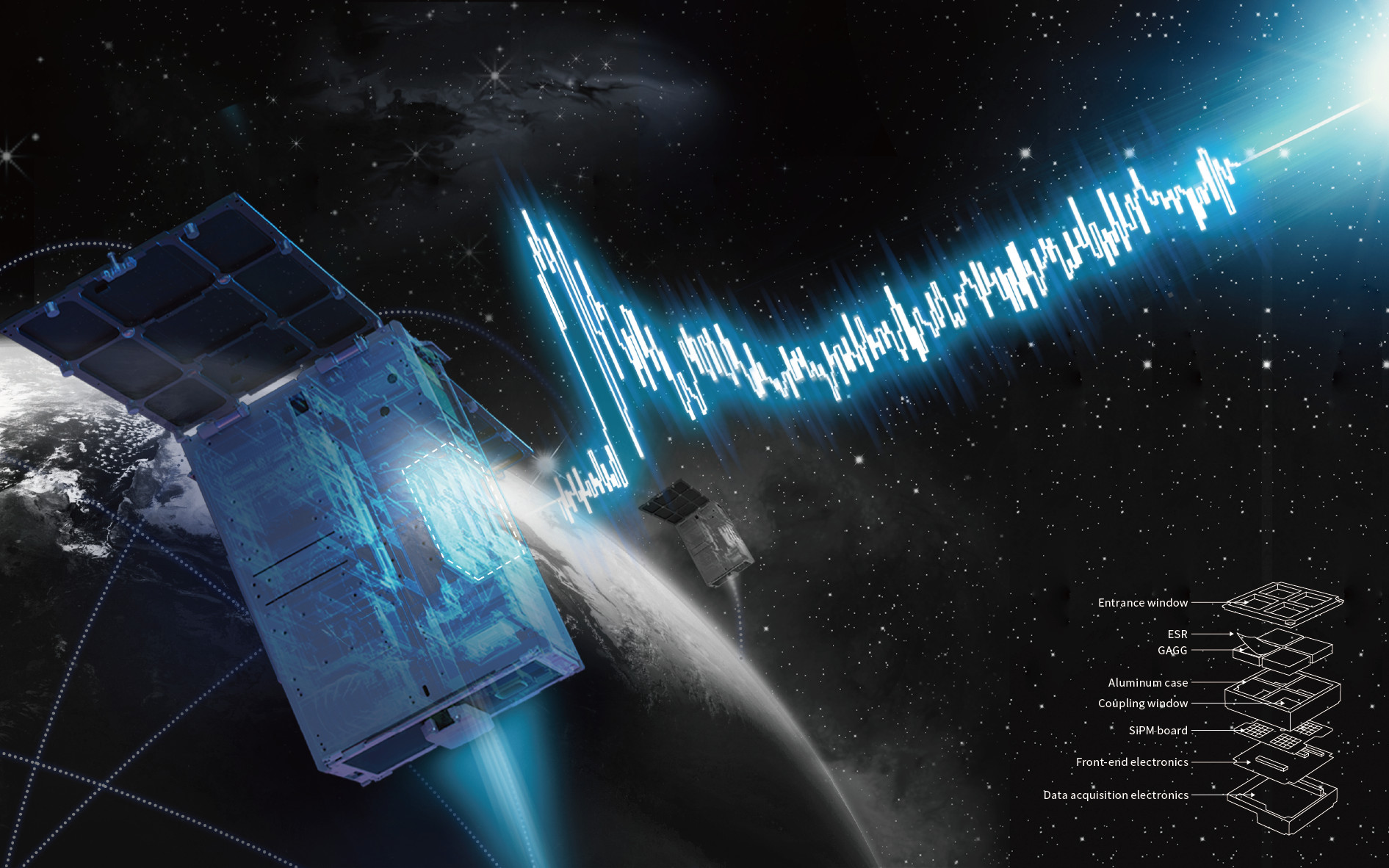
Each GRID detector employs a compact design (9.4×9.4×5.0 cm, 0.5U) with ~58 cm² effective area, covering 10 keV to 2 MeV. The detector consists of four independent channels, each comprising:
- A 1-cm-thick GAGG:Ce scintillator crystal (3.8×3.8 cm²)
- A 4×4 silicon photomultiplier (SiPM) array (MicroFJ-60035-TSV model)
- Front-end electronics and data acquisition system
- ARM Cortex M0+ microcontroller or ZYNQ FPGA
The detector employs SiPMs instead of conventional PMTs, offering advantages including low operating voltage (28.5 V), compact size, and insensitivity to magnetic fields.
The detector has an energy resolution of ~9.5% at 662 keV. The system is available in two configurations: the MCU-based version features a power consumption of ≤3 W and a dead time of ~15 μs, running firmware based on a Real-Time Operating System (RTOS); the FPGA-based version operates at ≤8 W with a dead time of ~3.4 μs, utilizing Linux-based firmware. Prior to launch, each detector undergoes rigorous ground calibration and space environment testing to ensure data accuracy and reliability.
--
每个GRID探测器采用紧凑型设计(9.4×9.4×5.0厘米,0.5U),有效探测面积约58 cm²,能量覆盖范围10 keV至2 MeV。探测器由四个独立通道组成,每个通道包含:
- 1厘米厚的GAGG:Ce闪烁晶体(3.8×3.8 cm²)
- 4×4硅光电倍增管(SiPM)阵列(MicroFJ-60035-TSV型)
- 前端电子学与数据采集系统
- ARM Cortex M0+微控制器 或 ZYNQ FPGA
探测器采用SiPM代替传统光电倍增管,具有低工作电压(28.5V)、小体积、对磁场不敏感等优势。
探测器能量分辨率在662 keV处约为9.5%。MCU版本系统功耗不超过3瓦,死时间约15微秒,固件基于RTOS实时操作系统;FPGA版本系统功耗不超过8瓦,死时间约3.4微秒,固件基于Linux系统。探测器在交付发射前经过严格的地面标定与空间环境测试。
Student-Led Model / 学生主导
GRID adheres to the educational philosophy of "student-centered, cultivation-oriented, interdisciplinary, and frontier-exploring." At Tsinghua University, the GRID student team is jointly supervised by faculty from the Departments of Engineering Physics, Astronomy, and Computer Science, engaging students across multiple disciplines, with over 200 undergraduates having participated. Student teams undertake hands-on work spanning the complete mission lifecycle—from scientific conceptualization and hardware development to instrument calibration, in-orbit observations, and data analysis. Knowledge transfer is achieved through a "senior-junior" mentoring system and periodic skills training. The project emphasizes developing students' system integration capabilities, leadership, and teamwork through authentic space mission experiences, providing a practical platform for training future leaders and technical experts for large-scale scientific projects.
--
天格计划坚持"学生主体、立足培养、学科交叉、探索前沿"的育人理念。清华大学的天格学生团队由工程物理系、天文系和计算机系教授联合指导,学生覆盖工物、物理、计算机等多个院系,累计吸纳200余名本科生参与。学生团队亲手完成从科学论证、硬件研制、性能标定、在轨观测到数据分析的全流程,通过"老带新"机制与周期性技能培训实现知识传承。项目强调在"真刀真枪"的小型航天任务中锤炼学生的系统集成能力、领导力与团队协作精神,为培养未来大型科学项目的领导者和技术骨干提供实践平台。
Scientific Discoveries and Achievements / 科学结果
As of 2025, GRID has confirmed detection of over 40 GRBs, and selected observations have been reported via GCN Circulars (link to GCN Circulars). Notable scientific achievements include:
- GRB 210121A (2021): GRID's first GRB detection, published in The Astrophysical Journal. This represents the first peer-reviewed scientific analysis of a gamma-ray burst based on Nanosatellite observations, confirmed by major missions including Fermi, Insight-HXMT, and GECAM. This burst provides strong evidence for the photospheric emission origin and serves as a typical case supporting the relativistic fireball model. DOI: 10.3847/1538-4357/ac29bd
- GRB 220408B (2022): The third GRB detected by GRID, co-detected by Fermi, Konus-Wind, and Astro-Sat. This burst exhibits three similar emission episodes explained by a precessing jet model, providing a new observational case for GRB central engine physics. DOI: 10.1088/1674-4527/acfa59
- GRB 230812B (2023): An exceptionally bright burst (T90 ≈ 3 s) detected by GRID-05B, sitting near the traditional boundary between long and short GRBs. Associated with a supernova and indicating a massive star progenitor, this burst challenges the conventional view that short-duration GRBs originate exclusively from compact object mergers. GRID-05B captured complete, unsaturated light-curve data of this bright burst, leveraging its compact detector array (multi-unit design) to provide new insights into the diversity of Type II GRBs. DOI: 10.3847/1538-4357/ada934
--
截至2025年,GRID已确认探测超过40个伽马暴,部分观测结果已发布于GCN Circulars(GCN Circulars链接),其中标志性科学成果包括:
-
GRB 210121A(2021):GRID的首个伽马暴探测成果,发表于The Astrophysical Journal。这是国际上首个经同行评议发表的、基于纳卫星观测的伽马暴科学分析,经Fermi、Insight-HXMT及GECAM等大科学卫星联合确认。该暴为光球层辐射起源提供了有力证据,是支持相对论性火球模型的典型案例。DOI: 10.3847/1538-4357/ac29bd
-
GRB 220408B(2022):GRID探测到的第三个伽马暴,经Fermi、Konus-Wind及Astro-Sat联合确认。该暴展现出三个相似的辐射阶段,可用进动喷流模型解释,为伽马暴中心引擎物理提供了新的观测案例。DOI: 10.1088/1674-4527/acfa59
-
GRB 230812B(2023):GRID-05B探测到的异常明亮伽马暴(T90≈3 s),处于传统长短暴分界线附近。该暴与超新星成协,表明大质量恒星起源,挑战了"短暴仅源于致密天体并合"的传统观念。GRID-05B利用其紧凑型探测阵列(多单元设计),成功获取了该极亮暴的完整未饱和光变数据,为理解II型伽马暴的多样性提供了新视角。DOI: 10.3847/1538-4357/ada934
Open Collaboration / 开放合作
The GRID collaboration network has expanded to over 20 institutions across China and internationally, including Tsinghua University, Nanjing University, Sichuan University, Beijing Normal University, Institute of High Energy Physics (CAS), and National Space Science Center (CAS). The project adopts a decentralized collaboration architecture where member institutions can jointly supervise student teams, develop and launch their own detector payloads, share data, and conduct scientific research. As of 2025, Nanjing University, Sichuan University, Beijing Normal University, and Hebei Normal University have successfully launched or are currently developing GRID detector payloads. This open model significantly lowers participation barriers and provides a practical platform for cultivating future leaders and core technical experts for large-scale scientific projects.
--
天格计划合作组(天格联盟)已发展至20余所国内外高校与科研院所,包括清华大学、南京大学、四川大学、北京师范大学、中国科学院高能物理研究所、中国科学院空间科学中心等。项目采用去中心化的协作架构,成员机构在合作组框架下可联合指导学生团队、研制发射探测器载荷、共享数据并开展科学研究。截至2025年,南京大学、四川大学、北京师范大学、河北师范大学等校均已成功发射或正在研制天格探测器载荷。这种开放模式显著降低了参与门槛,并为培养未来大型科学项目的领导者和技术骨干提供了实践平台。
Data Access / 数据开放
The first batch of observational data has been archived at the National Space Science Data Center; all data will be made openly accessible to the scientific community in real time once the analysis pipeline is fully operational. The detector response matrices have been validated through Geant4 simulation and ground calibration data, showing consistency with cross-calibration results from established missions like Fermi/GBM.
--
第一批观测数据已汇交国家空间科学数据中心,未来将全部即时对科学界开放共享(待Pipeline完善运行)。响应矩阵已通过Geant4模拟与地面标定数据验证,与Fermi/GBM等成熟任务的交叉定标结果一致。
Future Outlook / 未来展望
GRID will continue to expand its constellation scale, aiming to build a complete GRB monitoring network consisting of 20–30 nanosatellites to achieve full-time and all-sky coverage. Meanwhile, the next-generation "GRID 2.0" will explore MeV gamma-ray imaging and spectroscopic surveys to further enhance detection sensitivity and scientific output, providing stronger support for the multi-messenger astronomy era.
Meanwhile, the GRID collaboration welcomes international participation, offering flexible collaboration models and diverse member roles ranging from joint data analysis and student team exchanges to cooperative research on detector technology and the launch of new payloads, aiming to advance research and education in nanosatellite constellation astronomy.
--
天格计划将持续扩展星座规模,目标构建由20-30颗纳卫星组成的完整伽马暴监测网络,实现全天全时覆盖。同时,下一代"天格计划2.0"将探索MeV能段伽马射线成像与谱线巡天,进一步提升探测灵敏度与科学产出能力,为多信使天文学时代提供更有力支撑。
同时,天格计划合作组持续欢迎国际成员加入,提供灵活的合作形式与成员角色——从联合开展科学数据分析、学生团队交流,到合作研究探测器技术,乃至共同研制并发射新的探测器载荷,以期探索纳卫星星座空间天文探测的科学研究与人才培养新模式。
Contact | 联系方式
GRID Collaboration | grid@tsinghua.edu.cn